ADA Portable Restroom Rental and the International Icon of Accessibility
When individuals talk about ease of access, they typically picture long-term structures, ramps poured in concrete, or automated doors at a healthcare facility or school. Portable restrooms rarely enter the conversation first. Yet for any individual hosting an event, taking care of a public occasion, coordinating an area gathering, or preparing general portable sanitation, the inquiry is immediate and functional: will every visitor be able to use the bathroom with dignity?
That is where the ADA mobile restroom matters, and where the International Symbol of Availability lugs genuine weight. The icon is not decor. It is a sign that a system is meant to offer individuals that need an obtainable bathroom area, and under federal ease of access standards, that recognition is needed for accessible portable bathroom units.
This topic tends to obtain lowered to an easy rental inquiry. Do I need one larger device with the wheelchair icon on the door? In technique, that framework is as well slim. Access is not only about getting an ada portable bathroom. It has to do with seeing to it the system is provided in the right number, determined correctly, and placed where someone can really reach and use it.
The requirement that regulates portable toilet accessibility
For portable toilet services in the United States, the regulating federal accessibility criterion is the 2010 ADA Specifications for Accessible Layout, as translated by the united state Accessibility Board and the Division of Justice. That matters since it provides owners, event coordinators, and rental customers a real lawful structure instead of guesswork.
People sometimes presume short-term arrangements operate under looser regulations. That assumption produces problems. The Accessibility Board has explained that availability scoping uses also at momentary occasions. If portable solitary user bathroom units are grouped in a collection, a minimum of 5 percent of the devices because cluster need to be accessible. That is among the clearest and crucial pieces of advice in this area.
The phrasing appears simple, yet the implications are worthy of focus. If you rent a financial institution of mobile commodes for a weekend arts fair, an exterior wedding celebration available to the public, a flea market, or a community celebration, the obtainable devices are not optional additionals. The demand relates to the collection itself. The temporary nature of the event does not erase the obligation.
That is often the first misunderstanding I see in conversations concerning mobile hygiene. The second is the concept that an unit counts as easily accessible just because it is larger than a common delay. Size alone is not the test.
What makes an obtainable portable toilet unit accessible
An ada easily accessible mobile washroom needs to do more than exist. It should meet the applicable technological requirements for toilet areas. According to the Access Board advice mirrored in the ADA criteria, that includes fixture clearances, transforming space, door navigating clearances, and applicable grab bar and water wardrobe clearance rules.
Those details are not aesthetic. They are the distinction between a system that can be used individually and one that only looks certified from a distance.
Turning space issues because an individual using a mobility device or various other flexibility device needs area to enter, setting, and exit securely. Door maneuvering clearance matters since the act of opening up a door can be hard or impossible if the area is as well tight. Get bars and water closet clearances matter because transfer and assistance are not abstract concepts. They are day-to-day needs for lots of users.
This is why the expression ada certified portable bathroom requirements must never ever be treated like box checking. The requirements talk to real human motion and real human requirement. An unit that brings the ideal tag but fails on sensible gain access to is not serving the purpose of the legislation or the individual standing in front of the door.
Why the International Icon of Accessibility matters
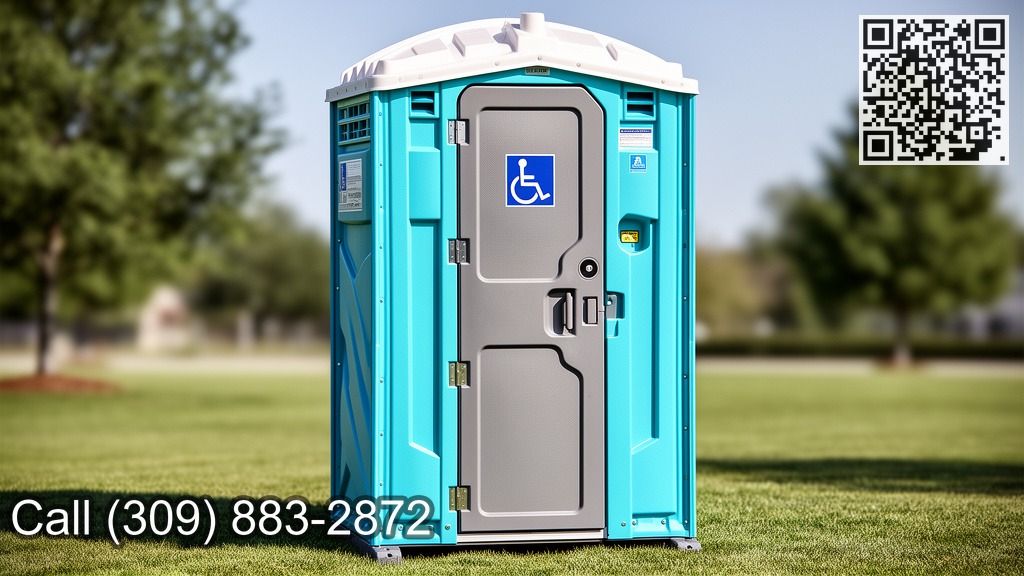
The International Sign of Availability is one of the most well-known public icons in the USA. On an accessible portable bathroom, it does an extremely certain task. Under the ADA criteria, easily accessible portable commode units have to be related to that symbol.
That identification offers a number of objectives simultaneously. First, it helps customers discover the appropriate device swiftly, especially in a row of similar looking commodes. Second, it indicates to team, guests, and the general public that access has been taken into consideration in the hygiene strategy. Third, it lowers complication in crowded settings where an individual might not have the moment, energy, or personal privacy to check every unit.
The sign additionally has a quiet yet vital social impact. It informs people with specials needs that a person expected them to be there.
That may seem like a little point, but it is not. At many events, people see right now when available centers were treated as an afterthought. They notice when the only larger system is hidden behind fencing, blocked by mud, or positioned much from the rest of the bathroom location. They notice when the icon is missing, leaving them to request for assistance in a circumstance where personal privacy matters.
Identification alone is not compliance, however lack of recognition is its own problem. A true ada compliant accessible portable toilet has to be both literally usable and noticeably designated.
Placement is where lots of access plans fail
A mobile restroom can meet the technological features inside the device and still stop working the bigger access test if no person can reach it. The criteria need an easily accessible course and available entrance. If ramps or landings are needed, those aspects also need to comply with ADA technical requirements.
This is just one of the most forgotten problems in ada portable commode rental preparation. People focus on the system and fail to remember the ground around it.
An accessible path is not a ritualistic path. It has to work for the real problems of the site. If the unit rests past rough surface, deep crushed rock, unpredictable yard, or an abrupt level modification without a certified option, the user has been rejected gain access to prior to they ever touch the door. The very same trouble develops when a device is parked where the entry location becomes unusable after rainfall or hefty foot traffic.
That is why positioning decisions must never be made by benefit alone. It is inadequate to say, "We have an ada certified portable bathroom someplace on website." The far better question is, "Can somebody reach it and enter it without unnecessary obstacles?"
This point becomes especially essential at temporary occasions because short-term frequently suggests improvised. Organizers are dealing with delivery windows, crowd flow, vendor places, secure fencing, energies, and unequal ground. It is simple for the easily accessible washroom to obtain pressed to the edge of the design. That sort of decision might fix a hosting issue for personnel while producing an access problem for guests.
The 5 percent policy, and what it indicates in the real world
The 5 percent demand for clusters of portable single user toilet units is easy to quote and in some cases harder for individuals to picture. The sensible lesson is that accessibility needs to be accounted for across each collection, not treated as an obscure assurance somewhere else on the property.
If there is one toilet bank at a site, the preparation concern is simple. If there are a number of separate restroom financial institutions, the analysis ends up being much more site certain because each collection issues. In everyday preparation discussions, this is where people commonly slip into oversimplification. They assume a solitary easily accessible device at one end of a big place covers all washroom requires. The scoping regulation presses against that shortcut.
This is not just a matter of arithmetic. Distance, group density, and path conditions all form whether gain access to is meaningful. While the verified criteria below speak directly to the 5 percent requirement and technical accessibility requirements, the spirit behind those regulations is clear enough. Available sanitation needs to belong to the real toilet plan, not a token accommodation that leaves one team with fewer choices and longer trips.
When clients ask about ada compliant portable bathrooms, they are often trying to prevent the evident blunder of renting out none. A better discussion goes one step even more and asks whether the arrangement of systems across the website shows how individuals will certainly relocate with the event or location.
Temporary does not indicate exempt
One of the strongest false impressions in this subject is the idea that a short-term arrangement runs away accessibility responsibilities. The Access Board advice clearly states that the relevant mobile toilet scoping uses even at short-term occasions. That point alone settles a great deal of confusion.
There is, however, a slim context that people occasionally find out about and misapply. The older 1991 requirements differentiated portable toilet devices at construction websites used solely by construction employees, treating those differently under the mobile bathroom access scoping requirement referenced there. That does not get rid of the obtainable device requirement for basic portable bathroom rentals. It merely indicates there is a details context that must not be delicately borrowed to justify noncompliance elsewhere.
This difference issues due to the fact that I have seen people make use of the expression "building and construction site rules" as if it were a broad exemption for any rough or momentary atmosphere. It is not. If the leasing is for basic use, the basic accessibility requirement continues to be in play.
That is particularly important for municipalities, nonprofits, colleges, event operators, and private coordinators that may assume that "short-term" and "casual" fit. Federal ease of access requirements do not go away due to the fact that the occasion lasts one day instead of one year.
What renters must ask prior to signing off
The most helpful conversations concerning an ada certified mobile bathroom happen before distribution. By the time the unit is in location and the crowd has arrived, preventable mistakes come to be expensive and embarrassing.
A tenant does not require to become a code specialist overnight, yet a few grounded concerns can prevent apparent failures.
- How many devices remain in each collection, and how will the easily accessible units be counted within that cluster?
- Will the available mobile toilet be noted with the International Icon of Accessibility?
- Is there an accessible course to the unit, consisting of the entrance area?
- If a ramp or touchdown is required, will certainly it satisfy the applicable ADA technical requirements?
- Has the placement been looked for practical use under likely site conditions?
Those inquiries are moderate, yet they change the tone of the rental process. They move the conversation away from "Send me one handicap device" and toward a much more accurate understanding of what an ada handicap accessible mobile restroom is supposed to accomplish.
Language matters here, too. Several customers still utilize older shorthand when consulting with vendors. The better focus is out tags alone but on whether the system and its placement please the identified ease of access requirements.
Compliance is wider than a sticker label on the door
Accessibility enforcement is not moving towards much less analysis. If anything, ADA compliance is significantly component of a broader society of functional responsibility. One recent instance outside portable sanitation helps make the factor. In April 2026, the Division of Justice prolonged the deadline for state and local government internet and mobile access guidelines to April 26, 2027 for larger entities. That advancement is not about mobile bathrooms directly, but it reflects a wider environment in which ease of access obligations remain active and noticeable throughout sectors.
For organizers and property supervisors, the lesson is basic. Access should be treated as component of preparation, not harm control.
That more comprehensive context issues because mobile washroom gain access to can look tiny theoretically while feeling enormous on the ground. If a visitor can go into a place, acquire food, and appreciate a performance but can not utilize the bathroom separately, the event has not been accessible in any kind of meaningful feeling. People keep in mind that experience, and they should.
Common judgment calls that deserve care
The hardest accessibility concerns are not always lawful puzzles. Commonly they are regular website decisions made under pressure. Should the easily accessible unit rest closest to the main group course, also if shipment is harder there? Should the washroom cluster be relocated to stay clear of mud, also if that creates a longer route? Ought to a different financial institution of typical devices be added near one area if doing so leaves the only easily accessible system farther away?
There is no global manuscript for those calls in the limited validated product below, but the requirements inform us where to maintain our focus. The easily accessible system needs to belong to the collection scoping, appropriately determined, reachable by an easily accessible course, and compliant in its entryway and bathroom area functions. When trade offs arise, those are not the things to deal away.
In actual preparation, access usually enhances when somebody takes a slower check out layout drawings or site maps. A system relocated twenty feet can make the difference in between a convenient path and an aggravating one. A delivery team notified in advance can avoid positioning the accessible entryway toward an obstruction. A fast area check after arrangement can capture a placement problem that was unnoticeable on paper.
None of that calls for grand language. It requires care.
The human side of a compliant setup
It is simple to discuss requirements in technological terms. Turning area. Maneuvering clearance. Easily accessible course. Those phrases are needed, however they can seem remote unless we attach them back to the factor they exist.
A person utilizing a wheelchair needs to not have to question whether the washroom marked for them is in fact usable. A parent assisting an adult relative must not need to browse a course that quits at soft ground or a high shift. A visitor with restricted stamina must not uncover that the only easily accessible unit gets on the far side of the place since somebody treated it as tools as opposed to a needed facility.
An ada portable bathroom is part of friendliness, public access, and fundamental regard. The International Symbol of Accessibility on the door should stand for a reliable pledge, not an enthusiastic guess.
That is why the very best ada compliant obtainable portable toilets are not born in mind for being special. They are born in mind for working without dramatization. Individuals find them, reach them, use them, and carry on with their day. That is specifically just how it ought to be.
What good planning looks like
Good preparation for ada certified mobile toilets is rarely flashy. It is thoughtful, particular, and a little repeated in the right ways. Somebody checks the variety of systems https://pristineportablesil.com/contact-east-moline/ in each cluster. A person verifies that the obtainable system is actually identified with the International Symbol of Access. Somebody checks out the course from arrival points, not simply from the delivery truck. Somebody takes notice of ramps and touchdowns if they are needed. Somebody confirms that the easily accessible entrance will certainly continue to be usable when the website is completely active.
That type of persistance is simple to ignore since it stops issues people never need to see. No irritated search. No unpleasant ask for support. No eleventh hour shuffle to move a system after complaints.
For renters searching phrases like ada compliant mobile toilet, ada compliant portable bathrooms, or ada compliant portable toilet, the most beneficial frame of mind is to think beyond the item name. You are not just leasing a box with extra floor space. You are arranging an obtainable bathroom room in a short-lived style, and the exact same severity must follow.
The lawful criteria give the framework. The icon on the door provides recognition. The route and entryway provide actual access. The technological features inside the system provide usability. Eliminate any kind of one of those pieces, and the whole setup starts to fail.
Accessibility in portable sanitation does not ask for excellence in every conceivable condition. It requests for conformity grounded in the ADA criteria and for planning grounded alike sense. For any kind of occasion or site open to the general public, that is not an unreasonable worry. It is the sensible minimum for dealing with people fairly.
And when the available unit is properly counted, appropriately put, correctly determined, and in fact useful, the outcome is more than conformity. It is relief, self-reliance, and the peaceful assurance that every person was expected to be there.
 Ask ChatGPT
 Ask Grok
 Ask Perplexity
 Ask Claude
 Ask Google AI
 Ask You